
 Back to Journal

.svg)
.svg)
.svg)
There is a quiet revolution happening in Ayurvedic skincare right now. And it does not involve a new synthetic compound or a lab-engineered molecule. It involves an ancient preservation process that Indian and Asian cultures have used for centuries, applied to one of nature's most nutrient-dense oils.
Fermented Moringa oil benefits are changing how the skincare world thinks about botanical ingredients. Not just what goes into a formula, but how it is prepared before it ever touches your skin. Because with Moringa, the difference between regular and fermented is not marginal. It is transformational.
What is Moringa? And Why Has Ayurveda Always Valued It?
Moringa (Moringa oleifera) is known across India as the drumstick tree. Every part of it has been used in Ayurvedic medicine for generations — the leaves, pods, roots, and seeds. In Sanskrit texts, it is called Shigru, described as one of the most therapeutically complete plants in nature.
Moringa seed oil is cold-pressed from the seeds of the drumstick tree and has been used in classical Ayurvedic formulations for skin barrier nourishment, wound healing, and complexion care for centuries. It is exceptionally rich in oleic acid (Omega-9), behenic acid, and a rare compound called moringa pterygospermin, which gives it natural antimicrobial properties unlike most other botanical oils.
Pure moringa oil in its unfermented form is already a genuinely impressive skincare ingredient. So why ferment it at all?
Why Fermented Moringa Oil? What Changes in the Process?
Fermentation is not a new idea. Ayurveda has its own fermentation science called Sandhana Kalpana — used to create potent medicinal preparations where the therapeutic value of an ingredient is amplified through controlled microbial activity. Korean skincare has long understood this too, which is why fermented ingredients have dominated that industry for years.
When organic moringa oil undergoes fermentation, several significant things happen at a molecular level:
The oil's fatty acid profile becomes more bioavailable. This means the skin can absorb and utilise the nutrients in moringa seed oil more efficiently than it can with the cold-pressed
version. The fermentation process essentially pre-digests the oil, breaking down larger molecular compounds into smaller ones that penetrate the skin barrier more effectively.
Beneficial organic acids and enzymes are produced during fermentation. These act as gentle natural exfoliants on the skin's surface, supporting cell turnover without any of the irritation associated with synthetic AHAs.
The antioxidant concentration in fermented moringa oil for face increases significantly compared to its unfermented counterpart. Studies on fermented plant oils consistently show elevated levels of free radical-scavenging compounds post-fermentation — which is directly relevant for anti-aging skincare and protection against environmental damage.
The antimicrobial properties that already exist in pure moringa oil become more potent through fermentation, making fermented moringa oil for skin particularly effective against acne-causing bacteria and fungal imbalances on the skin's surface.
This is why fermented moringa oil benefits go beyond what regular moringa oil benefits can deliver. Same plant, same seeds, profoundly deeper results.
Amazing Benefits of Moringa Oil for Skin and Face
Skin Barrier Repair and Deep Nourishment
The skin barrier is your skin's first and most important line of defence. When it is compromised, everything suffers: moisture escapes, irritants enter, glowing skin becomes an impossibility, and sensitivity spikes.
Fermented moringa oil for skin is exceptionally high in oleic acid, a fatty acid that mirrors the composition of the skin's own sebum. This structural similarity means the oil integrates into the skin barrier rather than sitting on top of it. It quite literally patches the gaps in a compromised barrier, restoring the skin's ability to retain moisture and protect itself. Among traditional Ayurvedic skincare ingredients, very few oils are as structurally compatible with human skin as Moringa.
Anti-Aging Properties Backed by Ayurveda and Science
One of the most significant fermented moringa oil benefits is its action on oxidative stress, which is the primary driver of visible skin aging. Free radicals from UV exposure, pollution, and metabolic processes break down collagen and elastin, leading to fine lines, dullness, and loss of firmness.
Fermented moringa seed oil contains elevated levels of isothiocyanates and flavonoids post-fermentation. Both are powerful antioxidants that neutralise free radical activity before it
can damage skin cells. Regular use visibly improves skin texture, reduces the appearance of fine lines, and restores that quality of skin that looks rested and alive.
In ayurvedic skincare, Moringa is classified as a Rasayana ingredient, meaning it supports cellular rejuvenation and long-term tissue health. The fermented moringa oil benefits for anti-aging skincare are therefore both Ayurvedically validated and scientifically grounded.
How Fermented Moringa Oil Helps with Acne and Blemishes
This is where people are often surprised. An oil, for acne-prone skin? The hesitation is understandable, but the science is clear.
Moringa oil for face is non-comedogenic, meaning it does not clog pores. Its oleic acid content actually helps regulate sebum production in oily skin rather than adding to it. The naturally occurring antimicrobial compounds in moringa seed oil, amplified through fermentation, actively work against Cutibacterium acnes (the bacteria responsible for inflammatory acne) without stripping the skin of its natural protective oils.
The gentle enzymatic exfoliation that fermentation introduces also helps prevent the buildup of dead skin cells that leads to congested pores and recurring breakouts. For anyone dealing with post-acne skin barrier damage, fermented moringa oil for skin supports healing while simultaneously preventing new breakouts from forming.
This dual action, treating current concerns while preventing future ones, is at the heart of the holistic approach that distinguishes Ayurvedic face oil formulations from conventional spot treatments.
Calming Sensitivity and Reducing Inflammation
Among the popular Ayurvedic skincare ingredients used for sensitive, reactive skin, fermented Moringa stands apart. The fermentation process produces short-chain fatty acids that have a documented calming effect on skin inflammation. For skin dealing with redness, rosacea-like flares, or sensitivity triggered by a disrupted barrier, this is genuinely valuable.
Natural ingredients for healthy skin work best when they address inflammation at the root rather than masking it. Fermented moringa oil benefits include reducing the production of pro-inflammatory cytokines in skin cells, which means the calming effect is happening at a biological level, not just on the surface.
Moringa Oil for Hair: A Bonus Worth Noting
Moringa oil for hair deserves its own mention. The same oleic acid richness that makes fermented organic moringa oil so effective on skin also makes it deeply nourishing for dry, damaged hair and scalp. Moringa benefits for hair include improved scalp circulation, reduced oxidative stress on hair follicles, and a conditioning effect on the hair shaft that reduces
breakage over time. Warm pure moringa oil massaged into the scalp before washing is one of the most time-honoured natural skincare rituals in South Indian Ayurvedic traditions.
Other Ayurvedic Benefits of Fermented Moringa Oil
Beyond the skin and hair, the holistic approach of Ayurveda looks at drumstick seed oil as a whole-body tonic. Moringa's internal consumption supports detoxification pathways in the liver, which directly influences skin clarity. In Ayurvedic medicine, the gut-skin axis is not a new concept. Shigru has been prescribed for centuries to address conditions that manifest both internally and externally.
The fermented moringa oil benefits extend to accelerated wound healing, reduction in post-inflammatory marks, and long-term improvement in skin resilience. These are not quick-fix results. They are the kind of steady, reliable improvements that come from using an ingredient that works with the skin's own biology rather than overriding it.
How to Use Fermented Moringa Oil in Your Skincare Routine
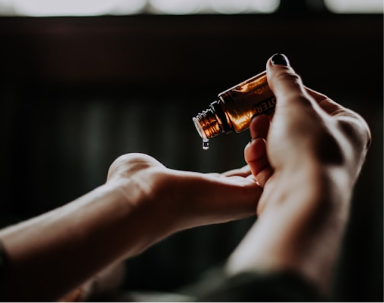
As a night treatment, apply 2 to 3 drops of fermented moringa oil for face after cleansing and before your moisturiser. The skin absorbs it most efficiently at night when its natural repair cycle is active.
For an intensive weekly treatment, mix a few drops into your regular face pack or Ubtan. The fermented oil enhances the penetration of other botanical actives in the mask, amplifying the overall result.
For moringa oil for hair, warm a small amount between palms and work through the mid-lengths and scalp an hour before washing. The heat from your hands activates the oil's absorption.
Among natural ingredients for healthy skin, few integrate as effortlessly or perform as reliably across multiple skin concerns as fermented Moringa. It is not a trend. It is Ayurveda's answer to what modern skin actually needs.
"Shigru Sarvarogaghnam" — Moringa, the healer of all ailments. The ancients were not exaggerating.
✦ Fermented Moringa oil benefits your skin the way Ayurveda has always intended. Not quickly. Not dramatically. But deeply, reliably, and lastingly.